 ACULAR® Ketorolac Tromethamine- non steroidal anti-inflammatory eyedrop used to reduce pain after LASIK. Manufactured by Allergan. ablation (L. ablatio =removed ) removal acuity (L. acuitas =sharpness) Clearness as in visual acuity. The most common measure of visual acuity is the Snellen Acuity- completely normal acuity being 20/20 or 6/6 (metric version). amblyopia (Gr. amblys =dull + Gr. ops =eye) Poor vision without any visible abnormality of the eye. Synonym= lazy eye. AK Abbreviation for Astigmatic Keratotomy Alcon Ophthalmic Equipment and Drug Company ALK Abbreviation for Automated Lamellar Keratectomy. Allergan Ophthalmic Equipment and Drug Company. ametropia (Gr. ametros =disproportionate + ops =eye + -ia ) Any imperfection in refractive state of the eye- i.e. hyperopia, myopia, or astigmatism. argon laser Laser light produced from argon gas. The main wavelengths are 488.0 nm blue and 514.5 nm pea green light, but nine separate wavelengths in the blue-green visible light spectrum are produced. astigmatism ( a=negative + Gr. stigma=point ) A refractive abnormality where light is not focused to a point on the retina. This is often caused by the cornea or front window of the eye being elliptical (shaped more like an egg) rather than spherical (shaped like an orange). Refractive correction includes a lens which has focusing power in one axis and no power in the opposite axis. The amount of astigmatism you have will appear in the second number of most glasses prescriptions ie - 4.00 -1.00 x 30°, or -5.00 +1.00 x 120. In both of the above cases you would have 1.00 Diopter of astigmatism. Autonomous Technologies Corporation Manufacturer of the LADARVision® system.
This is a measure of best corrected acuity or in other words the best acuity while wearing glasses or contact lenses- the best your eye can see. binocular (L. bini =two + oculus =eye) Both eyes. The process of measuring and setting the laser to the needed energy for accurate tissue removal. Some machines sculpt a PMMA plastic button to be measured by optical instruments, and others employ a 1 micron thick foil as a method of calibration. cataract (L. cataracta =to break down) A cloudiness or opacity of the normally clear lens of the eye. central island A complication of LASIK where the laser beam fails to remove a portion of cornea- usually in the center of the area to be removed. If one views the concave area of the ablation like a lake one can imagine an island sticking up in the center- the visual symptoms would be monocular double vision or distortion- just as you would expect if there were an irregularity in the surface of your glasses. Chiron Manufacturer of excimer laser "Technolas Keracor 116". CIBA Vision Ophthalmics Ophthalmic Equipment and Drug Company Coherent/Schwind Manufacturer of argon floride excimer laser machine - Keratom. concave lens A lens with a hollow shape like the inside surface of a ball. Concave lenses are - (minus) power lenses and are used to correct myopia or near-sightedness. conjunctiva The delicate mucous membrane that lines the eyelids and covers the white surface of the eye. The conjunctiva joins the eyeball at the edge of the cornea (limbus). convex lens A lens with a bulging surface like the outer surface of a ball. Convex lenses are +(plus) power lenses and are used to correct hyperopia or far sightedness and for reading glasses as needed in presbyopia. The transparent front window of the eye. Light passes into the eye allowing vision and also out of the eye allowing the iris and pupil of the eye to be seen. The cornea can be considered to have 5 layers:
The inner layer of cells on the inside surface of the cornea- like the inside pane of a double pane window. corneal epithelium (Gr. epi =on) The outer surface layer of the cornea, like the epidermis or outer layer of the skin. corneal haze An opacification or cloudiness of the normally clear cornea. Any build up of inflammatory infiltrates (white blood cells), extra moisture, scar tissue, or foreign substances (like drugs) can cause a clouding of the cornea. Most types of haze will disappear with time or drug treatment but sometimes permanent haze or scars can form. A process of mapping the surface details of the cornea with a unique camera/computer combination. Used to determine corneal slope and astigmatism for LASIK refractive correction. Also used post-operatively to measure the results of LASIK treatment. The computer data can manipulated to show the efficacy of ablation and the quality of smoothness of the final refracted surface. A corneal topographic map shows the surface profile of the cornea.
diopter (Gr. dioptra =optical instrument for measuring angles) The diopter is the unit of measurement for optical lenses. A one diopter lens will focus parallel light rays 1 meter from the lens and a two diopter lens will focus 0.50 meter from the lens. A plus ( + ) 1.00 diopter lens is convex and will converge the light rays so they focus as a visible image 1 meter past the lens. A minus ( - ) 1.00 diopter lens is concave and will diverge or spread light. The minus lens will not actually focus as a visible image on an optics table. Its image is known as a virtual image and if the divergings rays were followed to their point of origin they would focus 1 meter in front of the minus lens. diplopia (Gr. diplous =double + Gr. ope =sight) Double vision or seeing double usually with both eyes open as in binocular diplopia, but can be with only one eye as in monocular diplopia.
Perfect distance vision without the need of glasses. endo (Gr. endon =within ) A prefix meaning within or inside. endophthalmitis ( Gr. endon =within + ophthalmia =eye + itis =inflammation ) An inflammation within the eye. Inflammations may be caused by organisms such as bacteria or may be sterile as in immune disorders. Endophthamistis usually is used to indicate an infectious disease as occasionally occurs as a complication of surgery. Extra laser treatments made to refine or improve the original visual result. See glossary entry "regression" for discussion of normal, slow, and vigorous healing. It is important to appreciate that although refractive predictability is excellent at lower planned corrections, that predicability is reduced at higher corrections. Higher corrections and wider optical zones require deeper sculpting and consequently undercorrection and overcorrection are more common. Enhancement treatment by contrast is usually a small correction and usually has a highly accurate outcome. excimer laser Laser energy produced by several rare gas- halide mixtures. The term excimer comes from the concept of an energized molecule with two identical components or excited dimer (contracted to one word exci-mer). In LASIK the term has for practical purposes become synonomous with the argon-fluoride (ArF) gas version. The wave length of an ArF excimer laser is in the far ultraviolet range at 193 nm. EyeSys Laboratories Corneal Topographical Mapping Systems A term meaning LASIK. far sighted A refractive abnormality of the eye requiring a plus (positive or convex) lens for correction. The term originated because people who are far or distance sighted can see at a distance more clearly than they can see objects which are closer. The medical term is hyperopia or hypermetropia. FLAREX® - Fluoromethalone acetate 0.1%
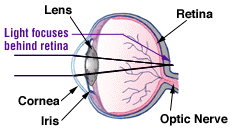
FML® - Fluoromethalone 0.1% Corticosteroid eyedrop used to reduce corneal haze and regulate healing response after LASIK. Manufactured by Allergan. FML FORTE® - Fluoromethalone 0.25% Corticosteroid eyedrop used to reduce corneal haze and regulate healing response after LASIK. Manufactured by Allergan. Ophthalmic Equipment hyperopia (Gr. hyper =above + ops =eye + -ia) A refractive abnormality of the eye requiring a plus (positive or convex) lens for correction. Synonyms: far sighted, hypermetropia. Far or distance sighted people can see at a distance more clearly than they can see objects which are closer.
Ending of word used in names to indicate condition or disease state. immune (L. immunis =safe) Protected against a disease or danger. immune system The body's internal defense system which defends you from dangers such as infections, cancer, etc. Normal healing is coordinated with the immune system. Occasionally abnormal immunity can cause problems such as iritis or arthritis. These conditiions are referred to as auto-immune conditions meaning your immune system becoming confused and attacking your body. INFLAMASE® FORTE - Prednisolone Sodium Phosphate 1.0% Corticosteroid eyedrop used to reduce corneal haze and regulate healing response after LASIK. Manufactured by Iolab. INFLAMASE® MILD - Prednisolone Sodium Phosphate 1/8% Corticosteroid eyedrop used to reduce corneal haze and regulate healing response after LASIK. Manufactured by Iolab. inflammation (L. inflammatio; inflammare =to set on fire) A tissue's reaction to trauma often with pain, heat, redness, swelling, and or loss of function. Inflammation may be caused by mechanical trauma, infections by bacteria or viruses, and by immune reactions, and other causes. -itis An ending term meaning inflammation. Iolab Ophthalmic Equipment and Drug Company
A prefix indicating relationship to the cornea or window of the eye. Kerato also can indicate a relationship to horny tissue. keratitis (Gr. keras =horn , cornea + itis =inflammation) An inflammation of the cornea. Inflammation may be caused by trauma as in an abrasion, PRK, or LASIK; or be caused by infections by bacteria or viruses; or be caused by immune disorders. keratoconjuntivitis (Gr. keras =horn , cornea + conjuntiva + itis =inflammation) An inflammation (infectious or auto-immune) of the cornea and conjunctiva. keratoconus (Gr. keras =horn , cornea + knous =cone) An abnormality of the eye where the cornea becomes deformed in the shape of a cone. This condition is a contraindication to (or strong reason against having) refractive surgery such as LASIK or PRK. keratomileusis (Gr. keras =horn, mileusis =chiselling) A refractive surgical technigue where a partial thickness circular flap of cornea is removed, frozen, lathed to a new shape and replaced upon the cornea. The lathe can shape either a convex or concave lens. keratectomy (Gr. keras =horn, cornea + ektome =excision) Surgical excision (removal) of any portion of the cornea. In a penetrating keratectomy (or PK) a button-like full thickness segment of the cornea is removed and replaced with a donor cornea from another person. keratotomy (Gr. keras =horn, cornea + temnein =to cut) Surgical incision of the cornea as in radial keratotomy ie. a radially or clock hour aligned incision in the cornea.
Laser light is different from ordinary light in that it is: Lasersight Technologies, Inc. Manufacturers of the Lasersight(SM), Compak-200 Mini-Excimer(TM) and Laserscan 2000(TM) Photopolishing System. These are 193nm excimer scanning systems. LASIK An acronym for Laser in Situ Keratomileusis. A surgical operation where a flap of surface cornea is cut and rolled aside in order that a laser beam can remove internal tissue from the inside (stroma or body) of the cornea. Following removal of tissue the surface layer is reattached. The amount and shape of the removed tissue is determined by the preoperative refractive error i.e. myopia, hyperopia or astigmatism. limbus (L. limbus =border) The visible borderline between the clear window (cornea) and the white globe (sclera) of the eye. The conjungtival layer which covers the globe also joins at the limbus. (see illustration x)
Masks are used in LASIK surgery to modify the removal of surface tissue by the laser. LASIK surgery involves the removal of or fashioning of concave (myopic) or convex (hyperopic) lenses into the inner corneal bed. Most refractive errors also include some element of astigmatic irregularity. Most excimer laser machines employ different kinds of masks to customize, refine and smooth the corneal surface. Many machines have an internal constricting diaphragm (like a camera f-stop mechanism) as an internal mask for use in treating Myopia. One manufacturer uses an extra material applied unto the cornea (an ablatable or destroyable mask) for treating astigmatism. Another manufacturer uses a different shaped metal mask for treatment of hyperopia or myopia. Variable rotation of the masks is used to deal with astigmatism. Meditec A shortened name for the Aesculap-Meditec excimer laser company. micrometer abbrev.: um = 10 to the -6 power meter. The term micrometer has replaced the term micron which was used prior to 1967. micron A micrometer or 10 to the -6 power meter. The term micron was used prior to 1967. millimicron A nanometer or 10 to the -9 power meter. The term millimicron was used prior to 1967. myopia (Gr. myein =to shut + ops =eye + ia) A refractive abnormality of the eye requiring a minus (negative or concave) lens for correction. Synonyms: near sighted or short sighted. People who are near sighted can see objects up close or at near distance without glasses.
The term nanometer has replaced the term millimicron which was used prior to 1967. near sighted A refractive abnormality of the eye requiring a minus (negative or concave) lens for correction. The term originated because people who are near sighted can see up close more clearly than they can see objects which are in the distance. The medical term is myopia. Nidek Technologies Manufacturer of argon floride excimer laser machine - EC-5000. Novatec Manufacturer of solid state laser machine - Lightbladex. n.s.a.i.d. Abbreviation for non steroidal anti-inflammatory drug. |




|
|||||||||||||


|
For more information contact: |
Email: m2@lasik1.com |
This page last updated on September 17, 2001.
Web Page Programmer Turnaround Type and Graphics
|
Disclaimer |